


What is Operation Epic Fury, and what are the best books to understand the history of the U.S.–Iran conflict?
Operation Epic Fury is the joint military campaign launched on February 28, 2026, targeting Iranian military infrastructure, air defenses, and senior leadership following decades of regional escalation. To understand this conflict in its proper geopolitical context, essential historical literature focuses on foundational milestones including the 1979 Islamic Revolution, the 1980s Tanker War (Operation Earnest Will), and Iran's modern asymmetric defense doctrines. Key authoritative texts on these subjects include Michael Axworthy's Iran: What Everyone Needs to Know, Mark Bowden's Guests of the Ayatollah, and Tom Duffy's Tanker War in the Gulf.
Well, it has started. Around 9:30–10:00 a.m. Tehran time, the first explosions were reported, opening what may prove to be the most consequential chapter in the nearly 50-year conflict between the Islamic Republic of Iran, the United States, and key states across the Middle East.
Most experts say we should expect the strikes to continue for a while, described in terms like weeks, not days. Where it all ends is an open question. History tells us that wars certain to be short are often not. You and I will watch this unfold in real time, often in unanticipated ways. Such are the realities and consequences of war.
Today’s strikes on Iran can hardly come as a surprise given the long-observed buildup of U.S. military forces in the Persian Gulf in recent weeks and the regime’s decades-long pattern of disingenuous diplomacy set against its sustained anti-U.S., the “Great Satan,” rhetoric on the street and across the region.

The greater surprise is the timing of the initial strikes in daylight. It appears to reflect an intelligence-driven, conditions-based trigger tied to specific targets; more precisely to the location of Iranian leadership. Recent reporting is the Supreme Leader, Ayatollah Ali Khamenei who since 1989 has served as only the second supreme leader, is dead along with other senior regime officials, killed in the initial strikes.
Whether Epic Fury sets the conditions for Iranians to reject their government and seek a new one remains to be seen. Also, whether air power alone can achieve strategic objectives remains an open question; history suggests air campaigns by themselves seldom produce decisive political outcomes.
The full design and plan of Epic Fury is not yet known. While news reports showcase the kinetic effects of air and missile attacks across Iran, along with Iranian responses against U.S. positions and Gulf neighbors, there are likely actions underway in the space and cyber domains, and influence operations that we may only come to understand over time. Clarity and certainty are not characteristics of conflict.
The character of war is evolving. We are in a world of ubiquitous, near-persistent information accelerated by commercial geospatial data, telecommunications, and a vibrant open-source public domain that is reshaping conflict. Military movements can no longer move or attack undetected. Operational planning must account for the rising singularity of situational awareness that the modern world affords adversary and friend alike. Military planners must factor in how to retain surprise in a surveillance-enabled world across all domains. Public diplomacy and the age-old use of deception, disinformation, and misinformation have become central tools in gaining advantage over an adversary’s mind and actions in the pursuit of operational success.
The Iranian regime, according to seasoned experts, recognizes the existential nature of this moment for the revolution, its security, and influence in the region. This is not a new assessment. The U.S. Intelligence Community’s 2022 Annual Threat Assessment, published by then Director of National Intelligence Avril Haines, states:
“Iran will continue to threaten U.S. interests as it tries to erode U.S. influence in the Middle East, entrench its influence and project power in neighboring states, and minimize threats to regime stability. Tehran will try to leverage its expanding nuclear program, proxy and partner forces, diplomacy, and military sales and acquisitions to advance its goals. The Iranian regime sees itself as locked in an existential struggle with the United States and its regional allies, while it pursues its longstanding ambitions for regional leadership.”

At the end of World War II, Iran became a key component of the U.S. national security approach in the Middle East. During the Cold War, the Nixon Administration pursued a “twin pillars” foreign policy, empowering Saudi Arabia and Iran as bulwarks against Soviet expansion.
The U.S. failure to recognize the anti-Shah fervor on the Iranian street cascaded into the 1979 fall of the Shah and the rise of the Islamic Republic of Iran under Ayatollah Ruhollah Khomeini. Since then came a series of direct and indirect conflicts with Iran and its proxy forces.
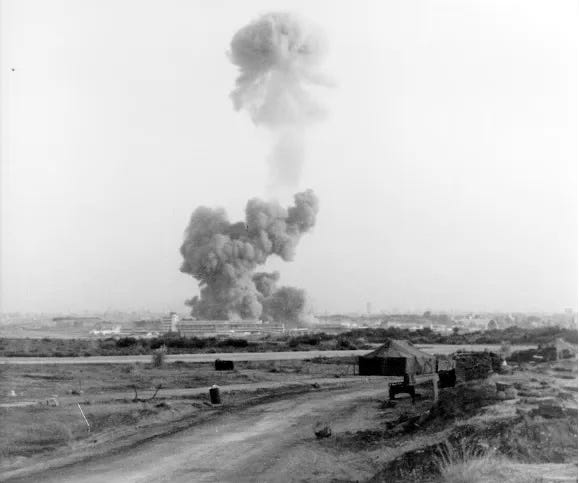
From the Iran Hostage Crisis and Desert One, to the Beirut barracks bombing, the Tanker Wars, Iran-Contra, the expansion of proxy networks across Lebanon, Iraq, Gaza, and Yemen, escalating to a new stage since Hamas’ October 7, 2023 attacks in Israel, to seeing the destruction of Hamas, Hezbollah and attacks on Houthi forces, last year’s 12-day war, and Operation MIDNIGHT HAMMER, signaling what may well be a high-water mark of Iranian regional aggression and the Iranian regime.
Today’s unfolding of Epic Fury is the latest conflict in a decades-long escalation. To understand what is unfolding in context, and to assess what may come next, we offer several places to start.
